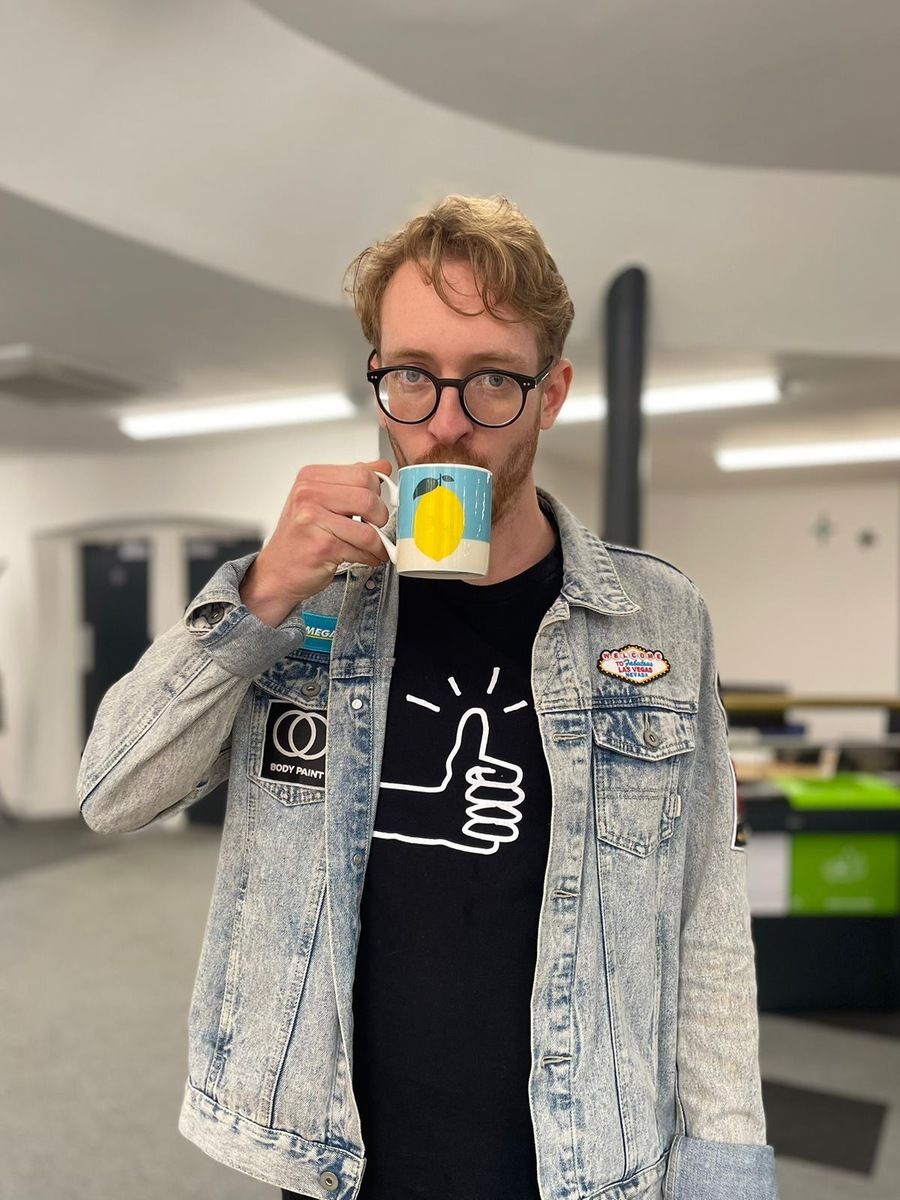
Some scribblings about my trip to Bulgaria. They’re lightweight and light-hearted. Perhaps something to peruse over a cup of tea? Better than scrolling Tik Tok.
Day 1
I bang my head on the boot-lid of the car as I load our suitcase in. I then spend some portion of the journey worrying that the pressure of flight will accelerate a lethal brain bleed. As usual, I am proven wrong.
Once we’re through security and in departures, Ellie turns to me with a sudden look of concern and asks “do you need a visa to get into Bulgaria?” We quickly and stressily establish that I don’t, then go to get Ellie her first ever airport pint. This at least distracts me from diagnosing myself with a terminally bonked noggin.
The flight is less than half full. Clearly not everyone had the bright idea of going to the Balkans in January. My first impression of Bulgaria is that their airport is surprisingly small. Bulgaria itself only has the population of three Birminghams.

A pic I took.
Day 2
On my first full day in Sofia we leave Sofia. And head to Pernik, an industrial centre that every Sofian (other than Stevens) is negative about: "Where does someone from Pernik greet their guests? In the hospital" - I think the joke was lost in translation, potentially by the sole baggage handler at Sofia Airport. As a lifelong Midlander, I feel strangely defensive of Pernik. Perhaps I should see if they want to be twinned with Birmingham.
We are in Pernik for the Surva Festival, a celebration of Bulgarian folklore that features many people dressed in big hairy costumes which I am very jealous of because it is -2 degrees. There are also people dressed as old ladies who throw flour at the crowd, chained bears who wrestle, and priests who marry pantomime dames to their husbands. The craftsmanship of the outfits for the kukeri (the hairy ones wrapped in strings of iron bells) is superb. They’re like dedicated cosplayers who honed their skills creating elaborate Comic-Con outfits and have now decided to dress as something culturally important instead.

Kukeri
The kukeri are meant to scare away the demons at start of the new year. My particular favourites have the chunky, hairy, bell-draped bodies, but also have giant oblong heads. It's like a Queens' Guard's bearskin hat has sprouted downwards and taken full control of its host. They twist and dance across the town square, their hair flailing and their bells chiming. It must be a hell of a workout.
After hours of standing in the cold, the final act process into the square. The group is 300-strong and the atmosphere immediately tips towards the feral. There were still bearskin boys twisting around, and traditional folklore dancers in pigtails and overalls, but another contingent were among their ranks. A gang of helmetted helmets, sporting ragged capes, naff halloween masks, and brandishing vuvuzelas. They paraded around the edges and, as they got closer, one turned to reveal that the ratty scrap tied around his neck was daubed in red, white, and black, forming a homemade Swastika.
Perhaps I won’t ask Pernik to twin with Birmingham after all, the kucheri still have some demons to chase out.
Day 3
I was told that, in Bulgaria, meals are a marathon rather than a sprint. I'm not sure that's quite right, as there's a lot of sporadic stopping and starting as everyone finds a pace that suits them. Meals in Bulgaria are actually a couch to 5k. Each meal progresses from pickled nibbles to larger nibbles, to salads, to mains, to desserts to more nibbles. It all comes out of the kitchen as it’s ready, and the main courses are ordered as and when each diner feels they are ready to order. This means I sit there with each course, unsure whether this is the one I need to fill up on, or if I need to leave room for a more significant course that is about to appear. This lackadaisical approach to food does not apply to drinks, however. You must wait for everyone's drink to arrive so that you can clink glasses and say 'nazdraveh' before taking your first sip. I always remember this seconds after taking that first delicious mouthful of my freshly pulled pint. I think this is why pints aren't filled to the brim in Bulgaria - it prevents that necessary first swig that gives you enough breathing room to return from the bar without coating the carpet in booze.
We have lunch at Happy, Bulgaria's homegrown fast food chain. It occupies the same spot as Nandos does in the UK - a good, reliable chain eatery which doesn't leave you feeling dirty. Unlike Nandos, it has a large sign saying that it is the best restaurant in London. Yes, not in Sofia, but in London. The claim is charmingly outrageous.
It feels like I’m not the only tourist in Sofia, as all the locals are also pausing to scrutinise the strange coins and unfamiliar notes - having only joined the Euro at the start of the month.
Day 4
We go up to the mountains, to a spa hotel. Sofia and its surrounding areas have many mineral springs, so the pools in the hotel are absent of chlorine stink and feel like hot baths.
We explore the local village, which is almost deserted. As we approach the one shop in the central square, the humans we see appear to be simultaneously intrigued by our presence and determined to ignore us. As we walk between some parked cars and the front of the shop, a large stray dog blocks our path. We step between the cars to walk around, and he bounds over to block us again. He is at least part German shepherd. We turn on our heels to head back the way we came, he moves around the outside to cut us off. It's not immediately clear if there is a playful glint in his eye or if we are about to be savaged.
We are not savaged.
The dog adopts us and takes us on a tour of the village, scampering along and then looking back to ensure that we are safe and following. He shows us snowy mountains and telephone poles with gigantic, abandoned stork nests improbably balanced atop them. He regularly double checks that we do not, in fact, have any snacks for him. He heroically protects us from a horse who dares to very slowly walk in our direction.

Horse
When we get back to the gates of the hotel, a Range Rover pulls up. The woman driving rolls down the window to ask "Mecho" where he thinks he's going. Mecho means 'teddy bear', and he is clearly a BNIV (Big Name In Village). After trying to convince him to head back towards the centre, and then using her car to attempt to herd him back in the right direction, she sees that he is a lost cause. We walk down the hotel's driveway and Mecho merrily trots along, probably looking forward to donning a white bathrobe and lounging in the sauna. We are met by the hotel security guard, who has been tipped off about Mecho's antics. The two clearly have history as Mecho turns and flees at the sight of him.
Day 5
Ellie regularly overhears amusing snippets of Bulgarian conversation and then has to wait until we're out of earshot to share them with me. In Sofia, some young lads walk past us and Ellie bursts out laughing. Apparently they said "typical Englishman". I don't think I look so blatantly English that I can be identified without saying a single word. I wasn't even vomiting in the street or helping myself to the country's cultural heirlooms. Clearly, I am wrong. In every restaurant we go to, Ellie starts looking at the menu and then says "oh, I'll ask if they've got a menu in English for you", but she never has to bother, because without me opening my mouth, the waiter has already handed me an English menu.
We walk to the multi-domed eastern orthodox cathedral. The same gigantic space that gives choirs heavenly reverb is applied to Ellie's sneezes, as they echo around the silent, reverent interior. I pray for her healing.
Outside, in the nearby park, there is a small flea market. There are some authentic Bulgarian wares, some tourist tat, and tables full of antiques: badges, hip flasks, spoons, medals. Each with swastikas and SS runes emblazoned on them. It's shocking to see, shocking that no one seems shocked. Shocking that, taking into account the full selection of items on offer, one could leave this flea market with an SS death's head branded pocket watch AND a vinyl copy of ABBA's Voulez-Vous.
Day 6
Ellie’s poor niece must be baffled by me. She’s only three, already bilingual, and I speak neither of her languages. She's trying though, bless her, trying to include the upsettingly English looking man who talks in gobbledygook.
I join in the call-and-response of naming animals in a children's book. She looks at me curiously when I excitedly say 'mecho' while pointing at a picture of a bear - perhaps this simpleton does know something. Even I occasionally think I know something, I think, through some kind of linguistic osmosis, that I am starting to understand Bulgarian. When said niece was deciding who should get the honour of reading the animal book, she instructs me to "sit here". Clearly the language had bypassed my brain and I understand her innately. Alas, no, Dutch is just a surprisingly close cousin of English. "Zit hier" is Dutch for "sit here".
I continue to sit in my assigned spot as we go through animal books. She is keen that I continue to learn things after the 'mecho' and 'zit heir' breakthroughs. Unfortunately she has clearly been learning things from other influences. It's not my place to criticise anyone's parenting approaches, but there's a point where things just go a bit too far. Everyone's entitled to their own political beliefs and perhaps there's a more lenient approach to these things in Bulgaria but I really have to object when Ellie's niece looks at me, looks at the animals, and then points at each one while saying "Kike! Kike! Kike!"
After a moment of shock, I am relieved to find out that Dutch isn't entirely similar to English. 'Kijk' is Dutch for 'look'.
Day 7
At lunch, I look at the drinks menu and see "grog" written there. I can't not order "grog". What even is "grog"? Surely it's going to be some kind of medieval tasting assault of flavours - probably brown and silty and quite unappealing. No, turns out grog is quite a flowery and delicate tasting cocktail, and I have mistakenly ordered a pitcher's worth.
We walk off the inadvertently boozy lunch, and finally I see the face I had expected to be gracing billboards, statues, and perhaps even a line of aftershave. Alas, he could only be found here, gazing out from a shop window amongst a selection of free postcards dated '2021'. Bulgaria's world famous sporting hero: Viktor Krum.
For the first time I find that I can relate to Viktor Krum. He is a foreigner visiting a magical place and clumsily attempting to adjust to its customs. He is a roughly sketched stereotype, “typical” of his nation. He, like me, grotesquely transformed his head into a shark's head for a bit. Or maybe that's just the grog talking.
Anyway, unless all of that was just a fever dream brought on by bumping my head on the car boot back in Birmingham, Bulgaria's great.
The latest episode of my podcast Watts on your Screen:
An investigation into ubiquitous stock imagery used to depict cyberspace, technology and the 1980s. I examine the pop culture of the 80s, the influence of technology, certain cities, and synthwave.